









wealthtrend
  • Home
  • Top News
  • Global

    The Global Interest Rate Turning Point: How Central Banks Are Changing Their Policies

    The New Shape of Global Trade and Finance: How Supply Chains and Currencies Are Moving

    The Rise of Digital Money:

    Finance in a Time of Geopolitical Tension:

    The New Shape of Work: How Technology Is Changing U.S. Jobs

    The New Forces Driving Global Markets:Technology, Demographics, and the Rise of Emerging Economies

    Global Payments at an Inflection Point: How Infrastructure, Regulation, and Geopolitics Are Rewriting the Future of Money

  • Asia-Pacific
    Japan’s Slow but Steady Recovery: How an Aging Nation Is Searching for New Growth

    Japan and South Korea: Comparative Economic Analysis and Future Prospects

    Japan’s Slow but Steady Recovery: How an Aging Nation Is Searching for New Growth

    South Korea’s Economy in Transition: Challenges, Opportunities, and the Path Ahead

    Japan’s Slow but Steady Recovery: How an Aging Nation Is Searching for New Growth

    South Korea’s Economic Transformation: From Manufacturing to Technology and Services

    Japan’s Slow but Steady Recovery: How an Aging Nation Is Searching for New Growth

    Japan’s Slow but Steady Recovery: How an Aging Nation Is Searching for New Growth

    Japan’s Slow but Steady Recovery: How an Aging Nation Is Searching for New Growth

    The Rise of Asia as the Next Global Financial Center

  • Europe

    The Social Foundations of Economic Stability: How France and Germany Are Managing Inequality, Welfare, and the Future of Work

    The Energy Transition Challenge: How France and Germany Are Rebuilding Their Economic Power Through Green Transformation

    France and Germany in a Shifting Global Economy: How Both Countries Are Rebuilding Their Competitiveness

    Germany’s Economy at a Turning Point: Slow Growth, Industrial Pressure, and the Search for a New Future

    France’s Economy in a Time of Slow Growth and Social Pressure

    The New Monetary Landscape of Europe: How the Eurozone Is Redefining Its Financial Future

  • viewpoint
  • America
  • Europe and America
wealthtrend
  • Home
  • Top News
  • Global

    The Global Interest Rate Turning Point: How Central Banks Are Changing Their Policies

    The New Shape of Global Trade and Finance: How Supply Chains and Currencies Are Moving

    The Rise of Digital Money:

    Finance in a Time of Geopolitical Tension:

    The New Shape of Work: How Technology Is Changing U.S. Jobs

    The New Forces Driving Global Markets:Technology, Demographics, and the Rise of Emerging Economies

    Global Payments at an Inflection Point: How Infrastructure, Regulation, and Geopolitics Are Rewriting the Future of Money

  • Asia-Pacific
    Japan’s Slow but Steady Recovery: How an Aging Nation Is Searching for New Growth

    Japan and South Korea: Comparative Economic Analysis and Future Prospects

    Japan’s Slow but Steady Recovery: How an Aging Nation Is Searching for New Growth

    South Korea’s Economy in Transition: Challenges, Opportunities, and the Path Ahead

    Japan’s Slow but Steady Recovery: How an Aging Nation Is Searching for New Growth

    South Korea’s Economic Transformation: From Manufacturing to Technology and Services

    Japan’s Slow but Steady Recovery: How an Aging Nation Is Searching for New Growth

    Japan’s Slow but Steady Recovery: How an Aging Nation Is Searching for New Growth

    Japan’s Slow but Steady Recovery: How an Aging Nation Is Searching for New Growth

    The Rise of Asia as the Next Global Financial Center

  • Europe

    The Social Foundations of Economic Stability: How France and Germany Are Managing Inequality, Welfare, and the Future of Work

    The Energy Transition Challenge: How France and Germany Are Rebuilding Their Economic Power Through Green Transformation

    France and Germany in a Shifting Global Economy: How Both Countries Are Rebuilding Their Competitiveness

    Germany’s Economy at a Turning Point: Slow Growth, Industrial Pressure, and the Search for a New Future

    France’s Economy in a Time of Slow Growth and Social Pressure

    The New Monetary Landscape of Europe: How the Eurozone Is Redefining Its Financial Future

  • viewpoint
  • America
  • Europe and America
wealthtrend
Home Asia-Pacific

South Korea’s reserves fall in 19 months

June 7, 2024
in Asia-Pacific, Financial express, Futures information, Top News, viewpoint
South Korea’s reserves fall in 19 months

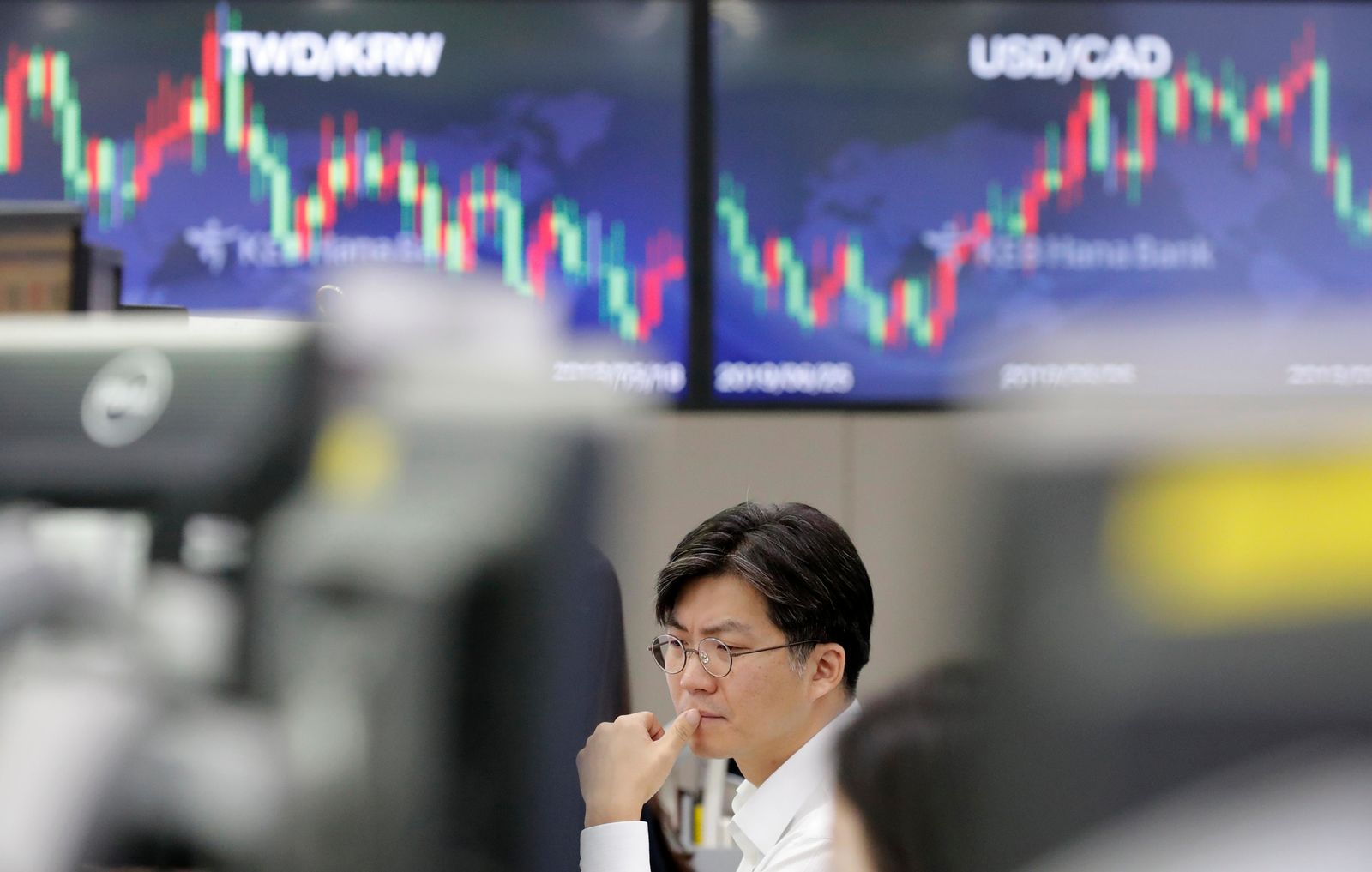
South Korea’s foreign exchange reserves fell the most in 19 months in April as authorities intervened in currency markets to curb the weak won, central bank data showed on Tuesday.

South Korea’s foreign exchange reserves stood at $413.26 billion at the end of April, down $5.99 billion from $419.25 billion the previous month – the biggest monthly decline since September 2022.

The central bank said the decline in foreign exchange reserves was due to market stabilisation measures, including the use of a currency swap line with South Korean pension funds, as well as a decline in foreign exchange deposits at financial institutions and a decline in the translated value of non-US dollar assets.

The won has depreciated more than 5 per cent against the dollar this year, making it one of the worst-performing currencies in Asia after the Japanese yen and the Thai baht.

In mid-April, the won briefly fell below the 1,400 mark, a level not seen since late 2022, alarming South Korean policymakers and prompting the authorities to issue a stern warning against excessive currency volatility.

After the Korean won fell below the landmark level, the Korean foreign exchange management department expressed its intention to actively intervene in the depreciation of the won. The Ministry of Strategy and Finance and the Bank of Korea said in a statement, Foreign exchange authorities are closely watching the exchange rate trend and the supply and demand dynamics of the foreign exchange market. Excessive unilateral fluctuations in the foreign exchange market are undesirable for the Korean economy. It is the first time in 22 months that the two agencies have jointly conducted verbal intervention in the foreign exchange market.

South Korean Finance Minister Choi Sang-mok, in a meeting with his Japanese counterpart Shunichi Suzuki that month, also jointly expressed “serious concern” over the recent depreciation of the currency and warned that appropriate measures would be taken to deal with any sharp fluctuations.

May South Korea be more anxious than Japan about currency depreciation?

Indeed, concerns about currency weakness have deepened across the region as the dollar continued to strengthen last month amid fading expectations of a Fed rate cut. The Japanese authorities were also suspected of intervening twice last week, directly by buying yen. According to a comparison of forecasts by Japanese bank accounts and currency brokers, the intervention funds spent by the Japanese authorities in the two operations may have been as high as 9 trillion yen.

Many industry insiders said that compared with Japan, South Korea may feel more anxious about the depreciation of the currency.

As a major global exporter and a key player in the technology supply chain, Asia’s fourth-largest economy has an export clout that transcends its economic size. But its exports are largely dependent on imports of raw materials, which are becoming more expensive as the won depreciates, and the growing trend towards offshoring means that dollar earnings do not necessarily all come home. The pain is particularly acute for small and medium-sized companies that are willing to hedge the exchange rate but still rely on raw materials from overseas.

Seoul-based Daeil Special Steel Co. Lee Eui-hyun, chief executive, said “a sense of fear is coming over me”. Mr Lee points out that Daeil is paying for higher-priced imports due to the current low exchange rate, while also facing pressure from competitors to cut prices.

Lee Sang-ho, vice chairman of the Federation of Korean Industries, a lobby group representing South Korea’s biggest companies, said that while large companies such as Samsung Electronics are often seen as benefiting from a weak currency because of their market dominance, the won’s recent fall to the 1,400 mark was unexpected for them.

Cho Gyeong Lyeob, a senior researcher at the Korea Economic Research Institute, said conglomerates that are borrowing money overseas to expand facilities, as well as steel, chemical and energy importers and airlines, were particularly affected. “The negative impact of the weak won is greater than the positive impact,” he said at a seminar.

Another significant difference between Korea and Japan is how investors react to foreign exchange moves — a weaker yen usually boosts Japanese stocks on expectations of higher yen-denominated overseas profits; But a weaker won tends to lead to lower share prices in the Korean market.

Share price movements are the result of a complex combination of factors, but at the end of the day, higher import costs squeeze margins, while a weaker won does little to boost exports. Investors are also worried that a rapid decline in the won could destabilize financial markets. “We should remember that exporters are also importers,” said Lim Kyung-min of the Korea Federation of Small and Medium Businesses. Prices of energy and raw materials in particular have risen sharply since the pandemic.”

Any competitive advantage South Korea may enjoy from a weak won could easily be eroded in markets where it competes with other Asian countries, which are climbing the supply chain ladder. Lee Jung-hoon, an economist at Eugene Investment Co., said the data showed South Korea’s exports weren’t growing at all because of the weak won.

The situation is particularly worrisome for companies that lack financial hedges against currency fluctuations. In a survey conducted by the Korea Federation of Small and Medium Businesses in August last year, when the dollar jumped 3 per cent to 1,322 won, about 49 per cent of small and medium-sized exporters said they had no special contingency plans. The survey also showed that less than half of exporters think the depreciation of the won is good for their profitability, while more than a quarter think it is bad for them.

For Daeil’s Lee, time is running out. A further weakening of the won could boost the price of both domestic and imported goods, adding to the burden on manufacturers like him. “We probably have six months to a year at most,” Lee said. After that, it becomes very difficult.”

Tags: Asia-PacificEuropefinanceFinance and economicsKorea
ShareTweetShare

Related Posts

Japan’s Slow but Steady Recovery: How an Aging Nation Is Searching for New Growth
Asia-Pacific

Japan and South Korea: Comparative Economic Analysis and Future Prospects

December 1, 2025
Japan’s Slow but Steady Recovery: How an Aging Nation Is Searching for New Growth
Asia-Pacific

South Korea’s Economy in Transition: Challenges, Opportunities, and the Path Ahead

December 1, 2025
Japan’s Slow but Steady Recovery: How an Aging Nation Is Searching for New Growth
Asia-Pacific

South Korea’s Economic Transformation: From Manufacturing to Technology and Services

December 1, 2025
Japan’s Slow but Steady Recovery: How an Aging Nation Is Searching for New Growth
Asia-Pacific

December 1, 2025
Japan’s Slow but Steady Recovery: How an Aging Nation Is Searching for New Growth
Asia-Pacific

Japan’s Slow but Steady Recovery: How an Aging Nation Is Searching for New Growth

December 1, 2025
Asia-Pacific

The Rise of Asia as the Next Global Financial Center

November 27, 2025
Load More
Leave Comment
  • Bitcoin on a rollercoaster ride The whole network more than 110,000 people exploded warehouse 2.9 billion yuan evaporation in 24 hours! What’s going on?

    Bitcoin on a rollercoaster ride The whole network more than 110,000 people exploded warehouse 2.9 billion yuan evaporation in 24 hours! What’s going on?

    0 shares
    Share 0 Tweet 0
  • There are always unconvinced want to try! The size of Nvidia’s short position is now comparable to Apple and Tesla combined

    0 shares
    Share 0 Tweet 0
  • The probability is about 75%! Will the G7 fall?

    0 shares
    Share 0 Tweet 0
  • A number of data point to the Japanese government intervention in the currency market after the “5 trillion” still depends on the United States

    0 shares
    Share 0 Tweet 0
  • How far can Tech stocks go to split on Fed expectations?

    0 shares
    Share 0 Tweet 0

Hot

The Social Foundations of Economic Stability: How France and Germany Are Managing Inequality, Welfare, and the Future of Work

December 2, 2025

The Energy Transition Challenge: How France and Germany Are Rebuilding Their Economic Power Through Green Transformation

December 2, 2025

France and Germany in a Shifting Global Economy: How Both Countries Are Rebuilding Their Competitiveness

December 2, 2025

Germany’s Economy at a Turning Point: Slow Growth, Industrial Pressure, and the Search for a New Future

December 2, 2025

France’s Economy in a Time of Slow Growth and Social Pressure

December 2, 2025
Japan’s Slow but Steady Recovery: How an Aging Nation Is Searching for New Growth

Japan and South Korea: Comparative Economic Analysis and Future Prospects

December 1, 2025
Japan’s Slow but Steady Recovery: How an Aging Nation Is Searching for New Growth

South Korea’s Economy in Transition: Challenges, Opportunities, and the Path Ahead

December 1, 2025
Japan’s Slow but Steady Recovery: How an Aging Nation Is Searching for New Growth

South Korea’s Economic Transformation: From Manufacturing to Technology and Services

December 1, 2025
Japan’s Slow but Steady Recovery: How an Aging Nation Is Searching for New Growth

December 1, 2025
Japan’s Slow but Steady Recovery: How an Aging Nation Is Searching for New Growth

Japan’s Slow but Steady Recovery: How an Aging Nation Is Searching for New Growth

December 1, 2025
Europe

The Social Foundations of Economic Stability: How France and Germany Are Managing Inequality, Welfare, and the Future of Work

December 2, 2025
Europe

The Energy Transition Challenge: How France and Germany Are Rebuilding Their Economic Power Through Green Transformation

December 2, 2025
Europe

France and Germany in a Shifting Global Economy: How Both Countries Are Rebuilding Their Competitiveness

December 2, 2025
Europe

Germany’s Economy at a Turning Point: Slow Growth, Industrial Pressure, and the Search for a New Future

December 2, 2025
wealthtrend

WealthTrend, as the leading financial information service platform in the industry, provides comprehensive, timely and accurate financial information services for investors and financial practitioners by virtue of its deep industry background, clear service purpose and unique characteristics.

Copyright © 2025 Contact: [email protected]

No Result
View All Result
  • Home
  • Top News
  • Global
  • Asia-Pacific
  • Europe
  • viewpoint
  • America
  • Europe and America

Copyright © 2025 Contact: [email protected]

Welcome Back!

Login to your account below

Forgotten Password?

Retrieve your password

Please enter your username or email address to reset your password.

Log In